




 A Documentary History of Islamic Education in Pakistan (1947-70) Vol: 1
The idea of compiling policy documents on Islamic education since 1947 to date was inspired by another such project conducted by the Islamic Foundation Bangladesh and published under the title Reports on Islamic education and Madrasah education in Bengal (1861 – 1977). The current project mainly aims to compile all major government-related policy papers and reports in a set of two volumes. The first volume consists of subject matter from 1947 to 1970, while the second volume covers period from 1971 to 2012. Our main goal behind undertaking this task is to make all such important policy papers available at one place to students, teachers and researchers of Islamic education. No such attempt has ever been made in Pakistan by any other research institution or individual author. Therefore we hope this project would be the first of its kind in Pakistan to collect and compile all policy relevant material at one place.
We also think that the publication of these volumes timely due to numerous global issues and debates around the nature and function of Islamic education. Rapid political and social developments at regional and global levels have pushed the academic and policy-oriented study of Islamic education to a center stage. Whereas this emergent trend among the academic community is encouraging, nevertheless it seems unfortunate that the broader area of Islamic education is reduced to the madrasa education only. For example, Christine Fair’s speech at the USIP in 2006 is broadly titled as Islamic education in Pakistan whereas the contents of her presentation are restricted to madaris only.[1]
In reality, Islamic education is a broader category incorporating not only madrasa education but other forms of religious instructions as well, for example, Islamic studies at the school, college and university levels of general education. And even this should be understood in the backdrop of all its social and educational diversity. The subject-matter contained in these two volumes highlights only one dimension of this diversity—the government-related reports and papers. Dealing with competing contestations in all its political and social manifestations is beyond the scope of this work. This issue takes us into the difficult terrain of defining and conceptualizing Islamic education. In order to escape the blame of being too narrow or too broad in our definition of Islamic education, an operationalization of the concept is opted which can accommodate diverse forms of Islamic education but in manageable limits. For instance, the definition adopted in these volumes goes beyond madrasas and includes formal instruction of Islamic studies in schools, colleges and universities and yet at the same time excludes various forms of informal religious instructions such as by parents and Islamic scholars in the everyday lives of Muslims. To sum up, the editors’ conceptualization of Islamic education is much broader than the conventional treatment of it. It not only includes formal university departments of Islamic studies but also madrasas and Islamic curriculum taught in schools and colleges in Pakistan. By Islamiceducation we mean (a) school and college levels instruction on basic Islamic beliefs, moral conduct, Islamic history and instruction on doctrinal sources; (b) higher education degree programs in various branches of Islamic studies (such as tafseer, hadith, fiqh, seerah) offered in the various department of Islamic studies/centers/religious studies; and (c) Islamic schools or Islamic centers of learning (madrasas) mostly in the private sector with affiliation to five major madrasa educational boards. The advantage of broadening the definition and scope of Islamic education to go beyond the narrow focus of only madrasas provides an enhanced opportunity for an improved understanding of this concept in all its societal and institutional complexity.
Another tricky issue that requires critical appraisal is the security-driven approaches to the study of Islamic education adopted by a body of semi-popular scholarship as well as the donor driven, policy advocacy research activity. The immediate driving force behind these approaches is the tragic incident of 9/11 and the post 9/11 developments. Consequently, an explicit or latent association is either assumed or being sought between all kinds of Islamic education and extremism and radicalism. This again misses the mark. Generalizations such as this ignore all inner complexities and diversities of Islamic education and hardly improve our understanding of it. The corpus of literature produced both by think tanks scholars and journalists on madrasas since the events of 9/11 is mostly based on unverified assumptions, unsubsatiated empirical evidence and totally unscientific methodology. Unfortunately, however, it is this corpus of literature that is often quoted as authentic source of current discourse on madrasa education.
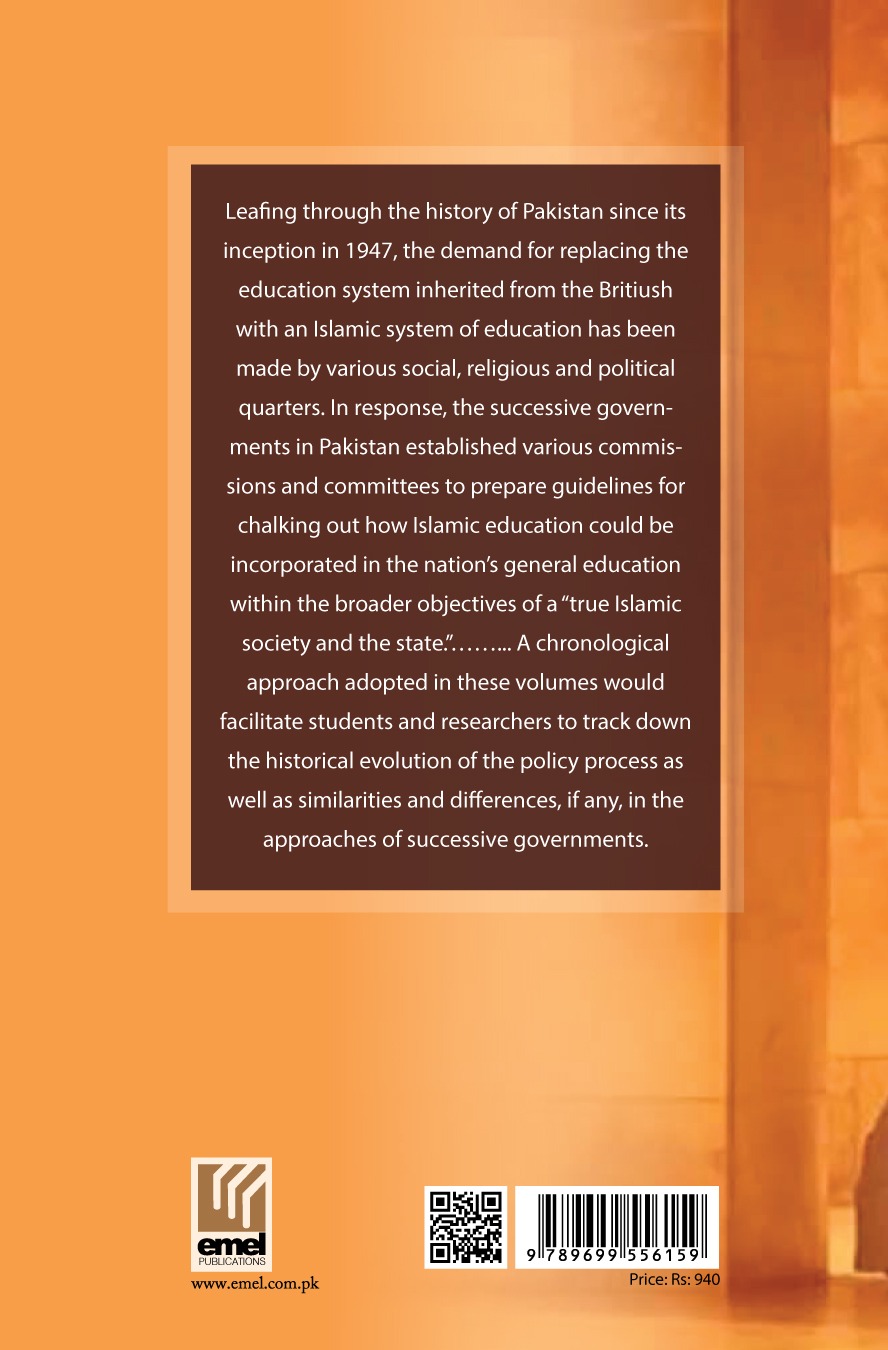
Leafing through the history of Pakistan since its inception in 1947, the demand for replacing the education system inherited from the British with an Islamic system of education has been made by various social, religious and political quarters. In response, the successive governments in Pakistan established various commissions and committees to prepare guidelines for chalking out how Islamic education could be incorporated in the nation’s general education within the broader objectives of a “true Islamic society and the state.” However, like most other commissions, such reports on Islamic education have mostly received scant attention of those who were supposed to implement their recommendations. In most cases, these reports remained under the consideration of concerned officials until the government that had initially commissioned the report changed and the new government came with its own ideas and policy priorities. A chronological approach adopted in these volumes would facilitate students and researchers to track down the historical evolution of the policy process as well as similarities and differences, if any, in the approaches of successive governments. It seems appropriate to provide a quick overview of the policy documents included in this volume.
In Pakistan’s political history, the era of President Ayub Khan (1958-1969) stands out by far the most important era of fundamental changes in political structure and economic and social policies. Deeply committed to economic development and modernization, Ayub Khan wanted to transform national education to meet the requirements of rapidly growing industrial economy. His idea was that national education must impart values of an enlightened, liberal Islam geared toward his goals of national development. The “Sharif Commission Report” issued in the early phase of Ayub regime is a testimony to the general excitement of the “decade of development” for creating a new Pakistan, modern but broadly Islamic. What the Ayub regime did not realize at the time was the modernization of education was not as easy as the modernization of economy and administrative structures. There was a vehement opposition from both the students who were not ready to accept additional requirements for graduation as recommended by the Sharf Commission, as well as by the right wing religious groups who saw in Commission’s report a direct assault on their idea of Islamic education. As a result of this opposition, the regime did not proceed with the implementation of the structural changes proposed in the report but was able to incorporate some reforms in the curriculum related to Islamic studies and general education.
The second period of educational reform was that of Prime Minister Zulfikar Ali Bhutto (1972-1977). Despite his deep commitment to egalitarianism, however, Bhutto’s educational reforms remined mostly confined to the nationalization of all educational institutions and did not address the fundamental issues of equal access to education, ideolological basis of education and the reorientation of the contents of Islamic education. One important development of this period was emphasis on the teaching of Arabic both as a result of the newly strengthened political and diplomatic links with the Arab Middle East and for the purpose of exporting Pakistani labor to the Gulf. However, the two reports issued during the Bhutto period on education hardly reflect his overall ideological thrust and rhetoric.
The third, and arguably most important, period that stands out by far the most comprehensive state-led Islamization program was that of Gen. Muhammad Zia-ul-Haq (1977-1988). Gen. Zia’s Islamization encompassed political institutions, economy, penal code, media and education. Gen. Zia made a series of attempts to Islamize the existing educational system as well as to introduce new trends in the educational institutions. Fundamental changes were introduced in the contents of Islamic education, especially at the school and college levels. It was also during this period that a serious attempt was made to examine the then existing state of madrasa education in Pakistan and to solicit the views of the ulama, educationists and madrasa administrators in order to introduce reforms in the madrasa system. “The Hallipotha Report” on madrasa education commissioned by the Zia government remains the most comprehensive effort so far to understand the dynamics of the traditional system of Islamic education. Despite the fact that the report was mainly based on the views of the ulama and was endorsed, at least in principle, by the madrasa ulama, its recommendations remained unimplemented both due to the lack of interest on the part of the government officials and because of the unwillingness on the part of the ulama to experiment with the system that, in their view and in their interest, was working well. Since this report was originally written in Urdu language so we will only provide a brief summary of the main components and recommendations of the report.
In addition to official documents, there exists a huge body of work on Islamic education produced by various scholars, organizations, policy institutions and madrasas. Our two volumes contain only government-related documents and have not included any of such papers produced in the private sector. However the IRD plans to collect and publish a careful selection of such reports/papers in another volume.
We all know that it is not always easy to find all the original sources, especially official documents pertaining to the early history of Pakistan, at one place. Scholars and researchers interested in the study of Islamic education have often faced this problem of access to source material. We hope that the present and the subsequent volumes will fill this important gap and will facilitate future research and inquiry in the area of Islamic education in Pakistan.
Mumtaz Ahmad
Husnul Amin
[1]See C. Christine Fair (2006) Islamic education in Pakistan. Available online at <http://home. comcast.net/~christine_fair/pubs/trip_report.pdf>


Reviews
There are no reviews yet.